Blog
News
NEW PUBLISHED PAPER
Congratulations to Runqi Kang for publishing Searching for Axion Dark Matter via Superconductor-Spin Hybrid Magnetometers in Physical Review Letters!
Axions are a compelling dark matter candidate suggested by theories beyond the standard model. The predicted axion-electron coupling and the resulting pseudomagnetic field allow for laboratory axion searches. Here we report an experimental axion search via a superconductor-spin hybrid magnetometer. A state-of-the-art broadband magnetometer with a sensitivity of sub-100 aT/sqrt(Hz) at tens of kHz has been realized by coupling a ferrite spin sensor to a readout system based on a superconducting quantum interference device. The most stringent terrestrial constraints on the axion-electron coupling have been established in the frequency range 5∼60 kHz. In the future, an improvement on the constraints of more than 3 orders of magnitude is foreseeable through arrays of superconductor-spin hybrid magnetometers with optimized designs. This Letter demonstrates the potential of superconductor-spin hybrid magnetometers in high-precision magnetic field sensing and the study of fundamental physics.
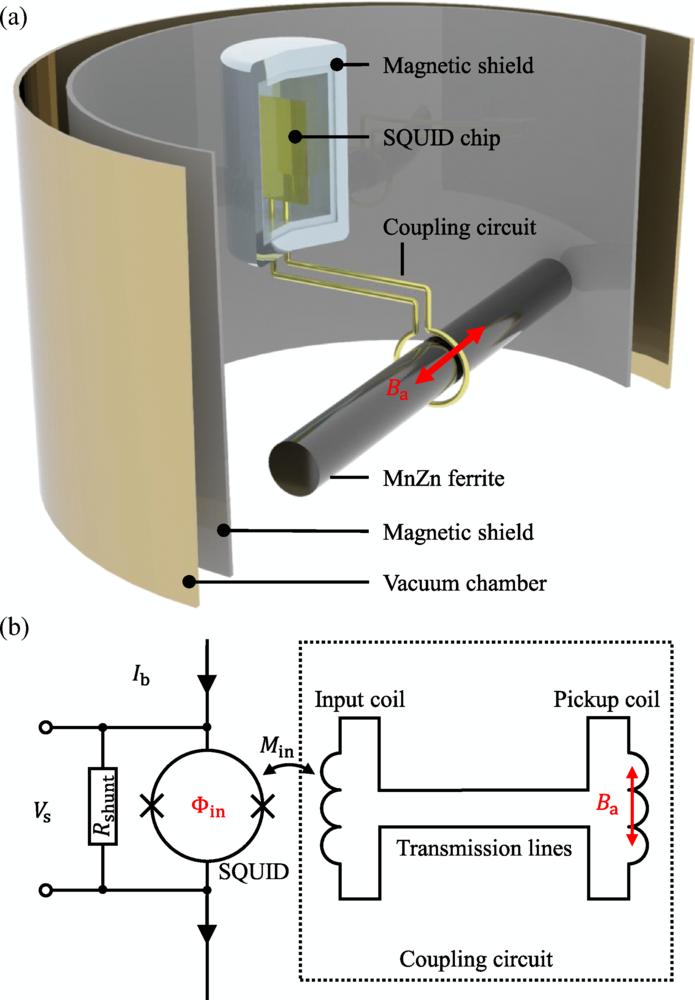 Fig.1 Experimental setup and circuit model for the SQUID. (a) The superconductor-spin hybrid system. A SQUID and a spin-based magnetic-field amplifier made of MnZn ferrite were placed in a magnetic shield and a vacuum chamber. The SQUID and the amplifier were coupled via a superconducting coil. (b) Circuit model for the SQUID. The axion-induced magnetic flux was transferred to the SQUID loop through a coupling circuit. The SQUID loop was biased by a DC current and traduce the magnetic flux into a voltage signal.
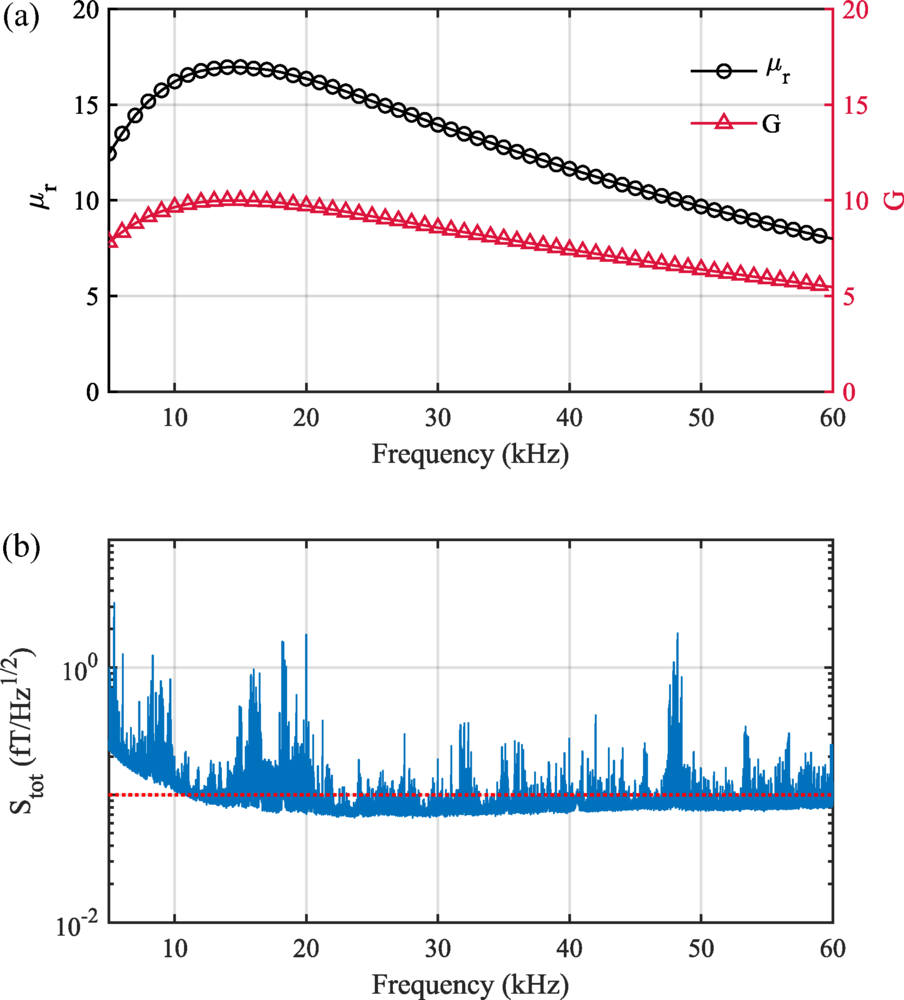 Fig.2 Calibration results. (a) Relative permeability and gain. The measured relative permeability μ r of the MnZn ferrite is shown as black circles. For every value for μ r , the gain of the magnetic-field amplifier can be obtained through finite-element simulation, as the red triangles shows. The lines are interpolations of the data points. (b) Sensitivity of the superconductor-spin hybrid magnetometer to a real magnetic field. The noise floor is below 100 aT/sqrt(Hz) (the red dashed line). Peaks in the spectrum are attributed to noise leakage from the environment.
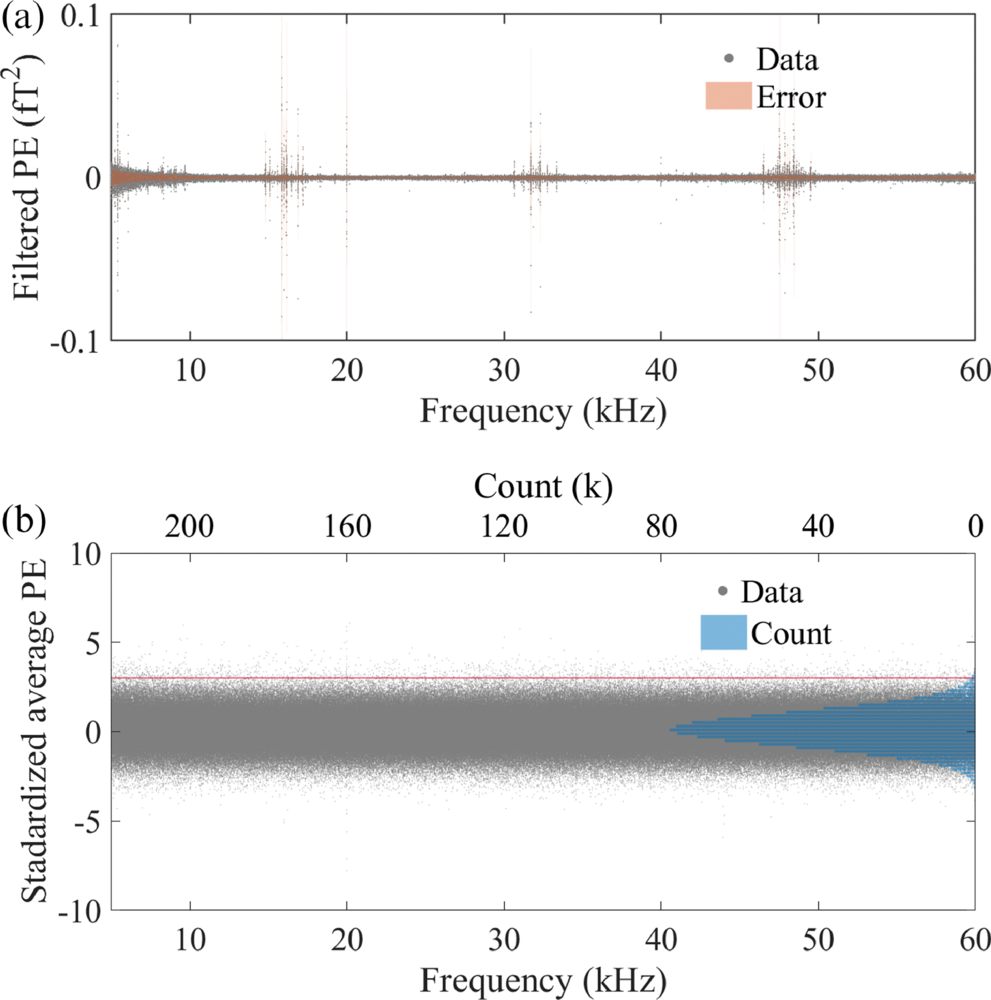 Fig.3 Results of Run 1. (a) One filtered PE spectrum of Run 1. (b) Average standardized power excesses. The gray dots are data points and the blue bars are counting results. 1728 data points exceed the threshold for an axion hypothesis. They are rejected in succeeding runs.
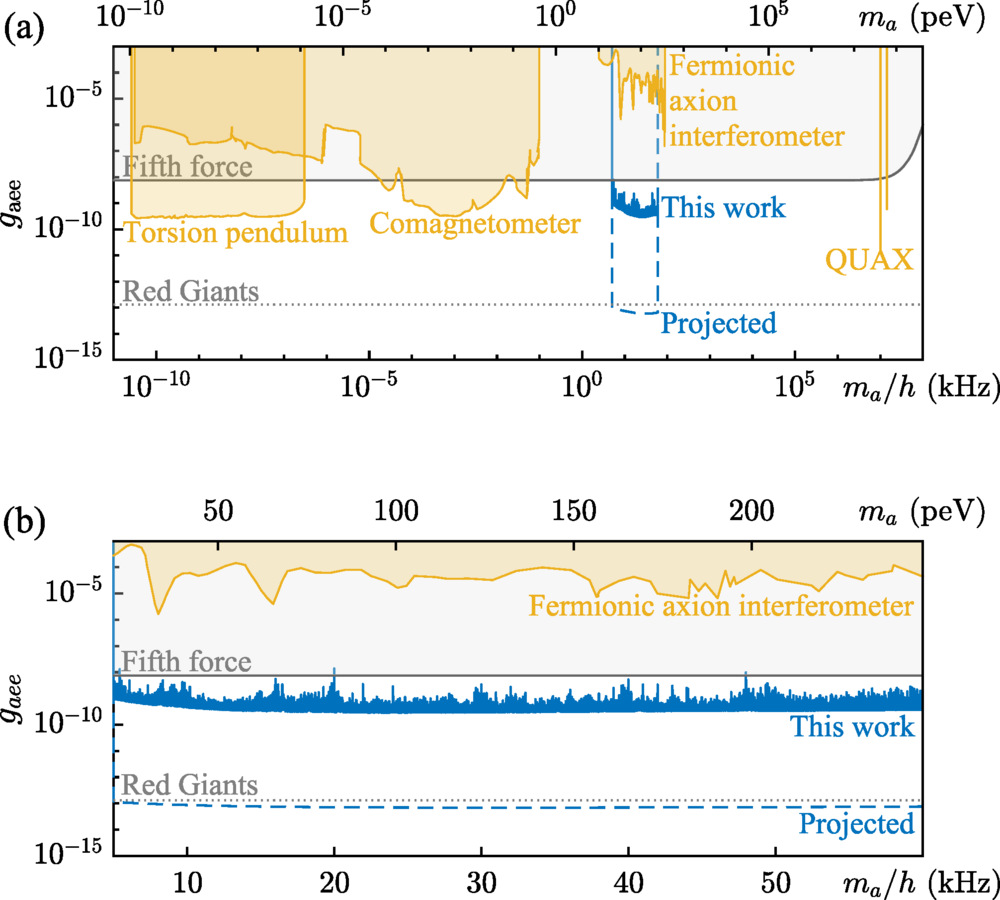 Fig.4 (a) Constraints on the axion-electron coupling as a function of the frequency and the axion mass. Our experimental results are shown as the blue solid line. The yellow and gray regions are the parameter spaces excluded by previous haloscopes [19, 20, 21, 22] and a fifth-force experiment [24], respectively. Astronomy limits on stellar axions are shown as the gray dotted line. With future optimization in the design and increase in the number of setups, our constraints can be improved by more than three orders of magnitude, as the blue dashed line shows. (b) Zoom-in of the frequency range 5∼60 kHz.